

Google Maps SEO for Painters
A practical guide for Australian painting businesses that want to understand, improve and measure their visibility in Google Maps.
Having a Google Business Profile does not mean your painting business will automatically appear strongly across every suburb you serve.
Maps visibility can change by search term and by location. Your profile, website, reviews, local authority and competition can all influence the overall picture.
I prefer to measure the starting point before changing anything. I want to see where the business is visible, where it becomes weak, and which painting searches actually matter.
Then I can decide what needs attention first.
Before looking at rankings, reviews or profile changes, it helps to understand what Google Maps SEO actually means for a painting business.
What Is Google Maps SEO for Painters?
Google Maps SEO for painters is the work involved in improving how a painting business appears in Google Maps and local search results.
For a painting business, this can matter when someone searches for terms such as:
- painter near me
- interior painter in their suburb
- exterior painter near me
- commercial painter in their city
- roof painting in their local area
Google Business Profile is an important part of this. But I do not see Maps SEO as only profile optimisation.
The website also needs to make the business and its services clear. Reviews can support both visibility and customer trust. Google can also use information about the business from across the web.
This is why I look at the whole local search presence rather than make changes to the Google Business Profile in isolation.
General SEO for painters can help a painting website appear in organic search results. Google Maps SEO has a stronger local and geographic element.
The same painting business can appear differently depending on what someone searches for and where that person is searching from.
So the goal is not simply to “optimise Google Maps.”
The first goal is to understand where the business is visible, what it is visible for, and where the gaps are.
That becomes easier once we understand how Google decides which local businesses to show.
How Google Maps Rankings Work for Painters
Google does not rank painting businesses from one single signal.
For local results, Google mainly looks at relevance, distance and prominence — how well-known the business is.
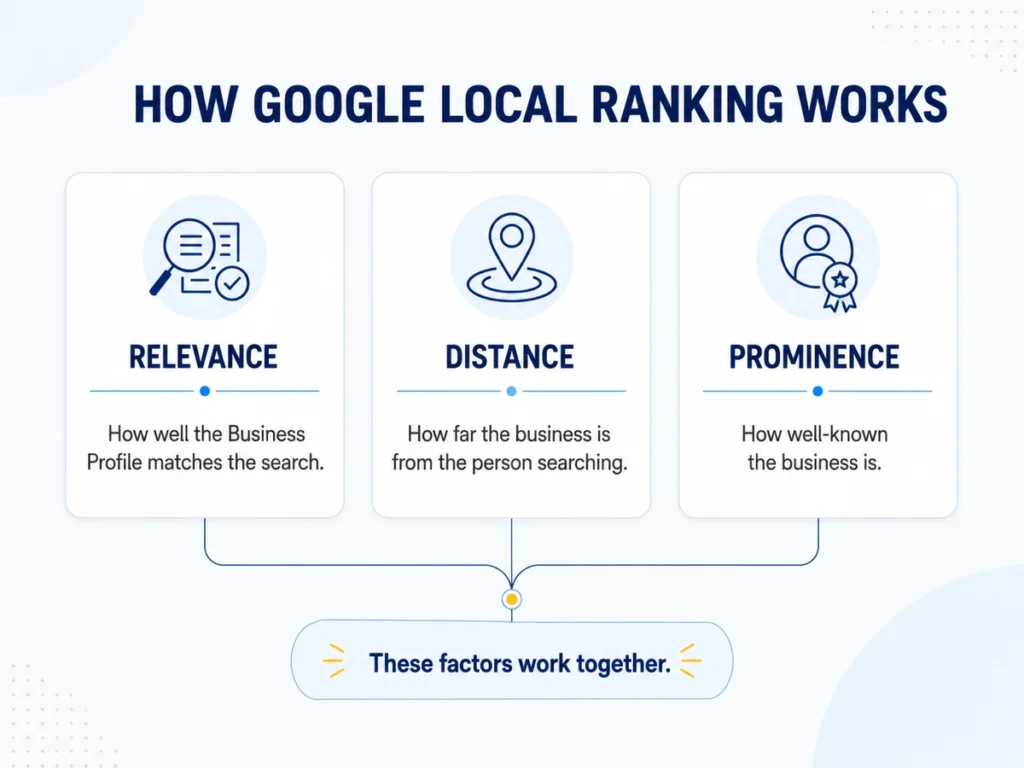
These factors work together.
For painters, this is important because two businesses can offer similar services and have similar reviews but still have very different Maps visibility.
Relevance
Relevance is about how well your business matches what someone is searching for.
If someone searches for an exterior painter, Google needs enough information to understand that exterior painting is genuinely part of what your business offers.
Your Google Business Profile helps with this. Your business category, services and other profile information give Google context about the business.
Your website should support that picture too.
For example, if commercial painting is an important service, I would want that service to be clearly explained on the website rather than mentioned once in a long list.
The aim is not to repeat keywords everywhere.
It is to make the business easy to understand.
Distance
Distance is different because you have much less control over it.
Google considers how far a business is from the person searching. If Google does not know the searcher’s exact location, it uses the location information available to estimate it.
This matters for painters because many painting businesses travel to customers across several suburbs.
A business may genuinely serve a large area without having the same Maps visibility across all of it.
This is also why adding more suburbs to your Google Business Profile service area should not be treated as a way to automatically rank in those suburbs.
Prominence
Prominence is about how well-known and established the business appears.
Google can use information it finds about a business from across the web. Links and reviews are among the signals Google mentions, and more reviews and positive ratings can help local ranking.
For a painting business, however, I would look beyond review count alone.
I would also look at the wider local presence. That can include the website, relevant mentions, links, business information and the strength of competitors already appearing in the area.
The important point is that no single factor explains every Maps ranking.
A painter with more reviews does not automatically have to rank above every competitor. A well-optimised profile also cannot remove the effect of distance.
That leads to one of the most important things to understand about Google Maps SEO.
Why Your Painting Business Can Rank in One Suburb but Not Another
A painting business can rank well in one part of its service area and be much less visible in another.
This is normal in local search.
Imagine your painting business is based in one suburb but regularly works across ten nearby suburbs.
Someone searching close to the business may see it near the top of the Maps results.
Someone searching several kilometres away may see a different group of painters.
The keyword can be exactly the same.
The location has changed.
Competition can also change from one area to another. One suburb may have several strong painting businesses nearby, while another area may have fewer.
So I do not expect one painting business to have exactly the same visibility everywhere it works.
Your service area is not the same as your ranking area
This is an important distinction.
Google Business Profile allows a service-area business to tell customers where it provides services.
But adding a suburb as a service area does not mean the business will automatically rank strongly there.
I would use the service-area setting to describe where the business genuinely works.
I would not use it as a list of suburbs where I expect Google to rank the business.
These are two different questions:
Where does the painter provide services?
and
Where is the painter actually visible in Google Maps?
They are not always the same.
One ranking check can give you the wrong picture
A business owner may search:
“painter near me”
from the office or home and see the business in position 2.
That sounds good.
But it only tells us what happened from that particular search location.
It does not tell us what a potential customer sees from another part of the service area.
That is why I do not judge Maps performance from one manual search.
This is where geo-grid tracking helps
I prefer to measure important painting searches from several points across the service area.
A geo-grid can show those rankings across a map.
For example, we may find:
Strong visibility close to the business → moderate visibility a few kilometres away → weak visibility farther across the service area.
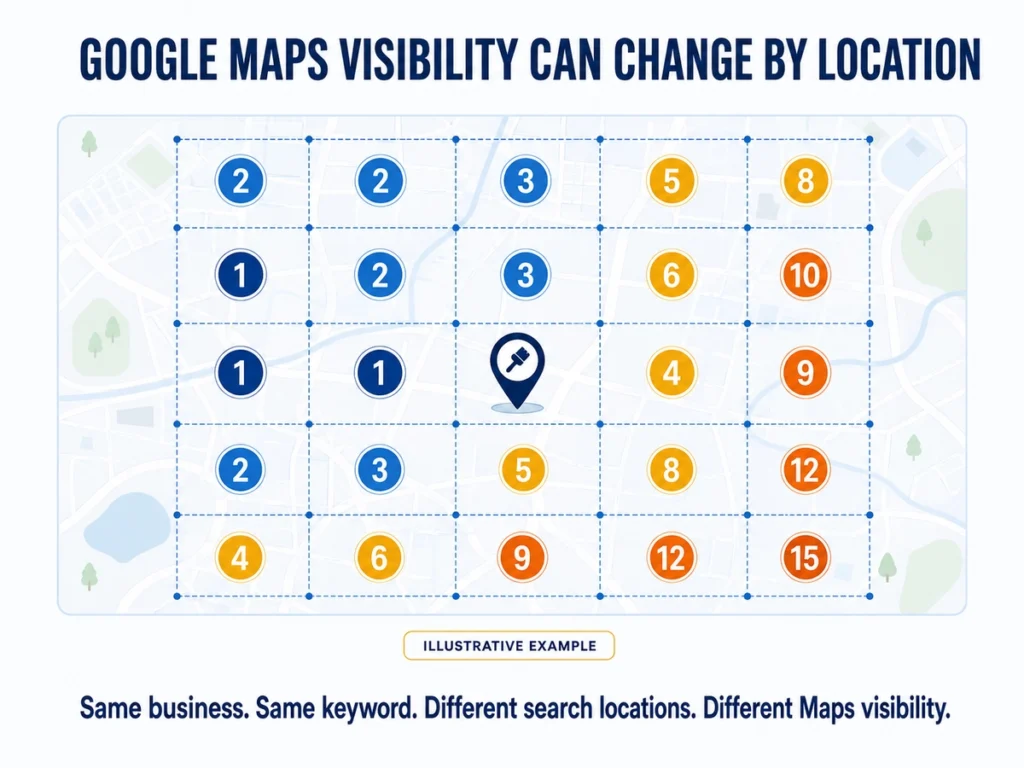
That gives us a much clearer starting point.
Maybe the business is weak everywhere.
Maybe it is strong overall but weak for one important service.
Or maybe the main visibility gap appears only in certain areas.
A geo-grid does not tell us the cause by itself. It is also not a Google ranking factor.
I use it as a measurement tool.
Once I can see the pattern, I can start investigating what may be contributing to it.
One of the first places I review is the Google Business Profile.
Google Business Profile Matters, but It Is Not the Whole Strategy
Your Google Business Profile is one of the most important parts of Google Maps SEO.
It gives Google information about your business. It also gives potential customers a quick way to see your services, reviews, photos, hours and contact details.
But a strong profile can still have limited visibility if other parts of the local search setup are weak.
Start with the right business category
Your primary category helps Google understand what type of business you operate.
For a painting business, the category should describe the business as accurately as possible.
Additional categories can be useful when they genuinely match other parts of the business.
But I would not add categories just because they contain keywords I want to rank for.
The goal is accuracy.
Make your painting services clear
The Services section gives you another place to explain what the business offers.
Depending on the business, this may include:
- interior painting
- exterior painting
- residential painting
- commercial painting
- roof painting
- cabinet painting
I would make sure the profile reflects the real services offered.
But I would not assume that simply adding a service will automatically improve the ranking for that keyword.
Keep the business information accurate
Basic information should reflect the real business.
That includes details such as:
- business name
- phone number
- website
- opening hours
- service areas
For service-area painters, the service areas should describe where the company genuinely works rather than locations added only for SEO.
Use photos to show real painting work
Painting is a visual service.
A potential customer may want to see the quality of the work before making a call or requesting a quote.
Real project photos can help with that.
Before-and-after photos can be especially useful. So can photos of interior work, exterior projects, commercial jobs and the team working on site.
I would use photos because they help customers understand and trust the business.
I would not promise that uploading a certain number of photos, or uploading them on a fixed schedule, will automatically improve Maps rankings.
The profile should represent the same business as the website
If the Google Business Profile says the company offers exterior, interior and commercial painting, the website should make those services easy to understand too.
This does not mean putting the same keywords everywhere.
It means creating a clear picture of what the business actually does.
For a deeper look at profile setup and optimisation, see Google Business Profile for painters.
One part of the profile deserves separate attention because it can influence both local visibility and customer decisions: reviews.
Reviews and Real Painting Project Proof
A customer cannot judge finished painting work from a business name or Maps position alone.
They usually want proof.
They want to see what type of work you have completed. They also want to know what previous customers experienced before deciding to call.
Reviews can support visibility and trust
Google says review count and positive ratings can help local ranking.
But I would not look at reviews only as an SEO signal.
For a painting business, reviews can also answer practical questions.
Was the painter reliable?
Was the work clean?
Did the team communicate properly?
Was the customer happy with the finished result?
These details can influence whether someone contacts the business after finding it.
So reviews have two important jobs:
They can support local visibility.
And:
They can help turn that visibility into an enquiry.
Ask for genuine reviews, not SEO-written reviews
It is fine to ask real customers for an honest Google review.
You can make the process easier by sending them a direct Google review link or QR code.
But I would keep the request neutral.
I would not ask for a five-star review.
I would not offer a discount or another incentive in exchange for one.
I would also not tell the customer to include a suburb, service or keyword because it may help SEO.
The review should reflect the customer’s real experience.
Respond to reviews for the customer, not for keywords
I also recommend responding to genuine customer reviews.
A useful reply shows that the business reads its feedback and takes customer experience seriously.
But I would not write responses simply to insert painting keywords or suburb names.
A short, genuine reply is usually better than turning every response into an SEO paragraph.
Real project photos are valuable proof
Painting businesses have a useful advantage here.
They can show their work instead of only describing it.
Useful proof may include:
- before-and-after projects
- interior painting
- exterior painting
- roof painting
- commercial work
- preparation work
- completed finishes
- the team working on site
Where possible, I would use real project photos.
If exterior painting is an important service, customers should be able to find both clear information about that service and examples of completed exterior work.
The Google Business Profile can show part of that proof.
The website can take it further.
Your Website Still Supports Google Maps Visibility
Google Business Profile is important, but I would not ignore the website behind it.
The website gives Google and potential customers more information about the business.
It can explain:
- what painting services you offer
- where you work
- what type of projects you handle
- why someone should trust the business
- how a customer can request a quote
Make your important painting services clear
If a service matters to the business, I want it to be easy to find and understand on the website.
For example, a painting company may offer:
- interior painting
- exterior painting
- residential painting
- commercial painting
- roof painting
Putting all of these into one short paragraph on a general Services page may not give customers enough information.
Important services often deserve their own useful pages.
An exterior painting page, for example, can explain the type of work offered, preparation, suitable properties, project examples and how to request a quote.
I would not create a separate page just because I found a keyword.
The service should be real, and the page should be useful to someone considering it.
Be careful with suburb and service-area pages
Location pages can make sense because most painting businesses work within defined areas.
But this is an area where I would be careful.
I would not create dozens of near-identical pages and simply replace one suburb name with another.
A useful suburb page should have a genuine reason to exist.
That could include:
- painting services available in that area
- real projects completed there
- relevant photos
- information specific to the area
- customer proof where available
- a clear way to request a quote
If there is nothing meaningful to say about a location, creating another thin page may not add much value.
I prefer fewer useful local pages over a large group of almost identical ones.
Keep important pages connected
Internal links help keep the website organised.
If you have a useful exterior painting page, it should not sit on the site with no links pointing to it.
The homepage, relevant service pages, project pages or useful articles can link to it when it makes sense.
The same applies to important location pages.
I would not force exact keywords into every link.
The anchor text should make sense to the person reading the page.
Keep the business information current
The website should also show accurate business information.
If the phone number or other important details change, I would update the places where customers may find the business.
This is not about trying to make every mention look artificially identical for SEO.
It is about avoiding outdated or conflicting information.
The website also needs to convert the Maps visitor
Ranking in Google Maps is not the final result.
A customer may discover the business in Maps and then visit the website before deciding what to do.
At that point, I would want the important pages to include:
- clear service information
- real project proof
- visible phone and quote options
- useful trust signals
- a simple contact path
The website therefore has another job.
It needs to help turn visibility into a real enquiry.
Outside the website, I also want to understand what the wider web says about the business.
Local Business Information and Authority
A painting business can appear on many websites and public sources outside its own site.
This is why I also look at the wider local presence.
The aim is not to get listed everywhere.
The aim is to keep important information accurate and build genuine authority over time.
Keep important business listings accurate
A painting business may appear on:
- local business directories
- trade directories
- supplier websites
- social profiles
- industry associations
- local chambers or business groups
- other relevant platforms
I would start with sources that are genuinely useful and relevant.
If an old phone number or previous business information is still appearing online, I would normally correct it where possible.
I see this mainly as good business-data management.
Customers should be able to find the correct information wherever they discover the company.
More citations are not always better
Citation building is common in local SEO.
But I would not measure success by how many directories a painting business appears in.
Getting listed on a large number of weak directories does not automatically make the business stronger.
I would rather focus on useful and relevant sources.
For an Australian painting business, that may include established local directories, appropriate trade organisations and genuine business platforms.
The exact mix should depend on the business.
I do not believe every painter needs the same citation package.
Relevant local mentions can be more valuable
I also look for opportunities that make sense in the real world.
A painting business may already have relationships with:
- paint suppliers
- builders
- property managers
- real estate businesses
- interior designers
- local organisations
- community groups
- trade associations
Some of those relationships can naturally lead to online mentions or links.
For example, a supplier may have a contractor directory.
A local organisation may mention businesses involved in a community project.
A trade association may have a member profile.
These are more natural than buying random links simply because they are sold as “local SEO backlinks.”
Links can support wider prominence
Google includes links from other websites when explaining local prominence.
But I would not turn this into a backlink-counting exercise.
One relevant local mention can make more sense than many unrelated links.
I would look at:
relevance, credibility and whether the connection is genuine.
The goal is to strengthen the real online footprint of the painting business.
Not to create links only for an SEO metric.
Once these different parts are in place, I still need to answer a practical question:
Is the painting business actually becoming more visible?
How I Measure Google Maps Visibility for Painters
I do not like to judge Google Maps performance from one ranking check.
So before making important changes, I build a baseline.
Track the painting searches that actually matter
I do not track keywords only because a tool suggests them.
I first look at the services that matter to the business.
For a painter, that may include searches such as:
- painter near me
- house painter
- interior painter
- exterior painter
- commercial painter
- roof painting
The exact keyword set should depend on the services the business actually wants more enquiries for.
A business may perform well for one service and poorly for another.
If we only track one broad keyword, we can easily miss that.
Measure visibility across the service area
I use geo-grid tracking when I need to understand the geographic pattern.
Instead of checking one position, I can measure the same search from multiple points across the local area.
This can show where visibility is strong and where it begins to weaken.
That is much more useful than simply saying:
“You rank number 3 for painter near me.”
The grid gives me evidence to investigate.
It does not diagnose the reason by itself.
Create a baseline before making changes
Depending on the project, the starting data may include:
- geo-grid rankings
- tracked local keywords
- Google Business Profile performance
- Google Search Console data
- website enquiries or other conversion data where available
Without a baseline, it becomes difficult to know whether the work actually changed anything.
Compare the same areas and keywords again
After important changes have had time to be processed, I measure again.
Where possible, I compare:
the same keywords,
the same geographic area,
and the same type of visibility data.
Then I can see what changed.
Maybe one service improved while another stayed weak.
Maybe visibility became stronger in some parts of the area but not others.
Those differences help decide what I should investigate next.
A real Australian painting-business example
I have used this approach with an Australian painting business.
I tracked important commercial painting terms across a 9 × 9 local grid covering an 8 km area.
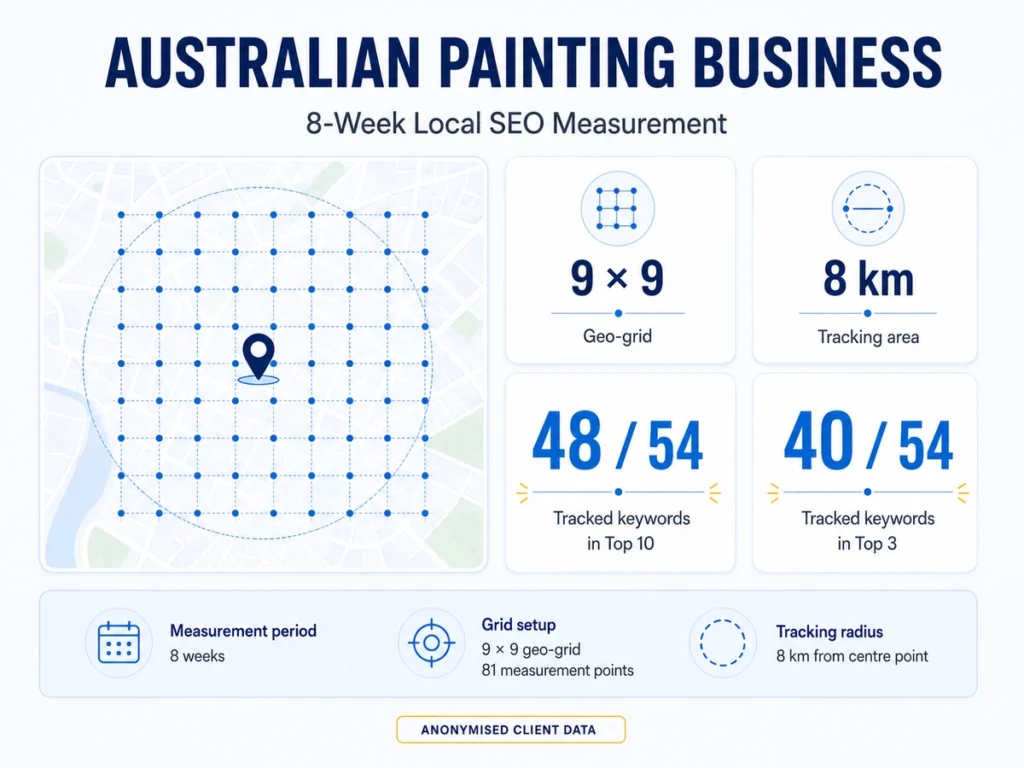
For the main tracked terms, the business already had strong Maps visibility. Wider keyword tracking also showed 48 of 54 tracked keywords in the Top 10, with 40 in the Top 3.
The useful part was not simply being able to say that rankings were strong.
The grid showed where visibility was strong and where there was still room to improve.
That gave me a better basis for deciding what to work on next.
See the 8-Week Local SEO Case Study →
Rankings are not the final result
A painting business ultimately needs enquiries and jobs.
So where the data is available, I also look at things such as:
- calls
- quote forms
- contact actions
- website traffic
- Google Search Console clicks and impressions
- Google Business Profile interactions
A ranking improvement is useful.
But I want to know whether the business is becoming easier for the right customers to find and contact.
The baseline tells me what changed.
The next job is understanding why the weak areas may be weak.
Diagnose the Weak Layer Before You Start Fixing Things
Once I have the data, I do not start changing everything at once.
I first try to understand which part of the local search setup deserves attention.
The same ranking problem can have very different causes.
| What I see | What I would check next |
|---|---|
| Strong visibility close to the business, but weak farther away | Distance, local competition and geographic coverage |
| Weak visibility across most of the grid | Profile relevance, website support, reviews, authority and competitor strength |
| Strong for one painting service, weak for another | Service relevance, profile information and the supporting website page |
| Good Maps visibility but few enquiries | Reviews, project proof, landing page quality and contact paths |
| A competitor ranks above the business with fewer reviews | The wider local setup instead of assuming review count is the reason |
| Rankings improve in some areas but not others | What changed, what may have helped and where the remaining gaps are |
This table is not a diagnosis by itself.
It tells me where to investigate next.
Do not assume the obvious reason is the real reason
One common mistake is to see a competitor with more reviews and immediately decide:
“We need more reviews.”
Reviews may be part of the picture.
But they may not be the main problem.
The competitor could also have stronger service relevance, a better website, more local authority, a different location or a stronger overall presence.
The same applies to citations, photos and backlinks.
I do not want to recommend more of something simply because a competitor has more of it.
I want to understand whether that area is actually weak for this business.
Separate what you can improve from what you cannot control
Some parts of Maps visibility can be improved.
For example:
- business information
- category and service relevance
- website content
- reviews
- project proof
- local mentions
- links
- internal linking
- contact experience
Distance is different.
You cannot move every searcher closer to the business.
So if the main pattern is geographic, I would not promise that profile changes will make the painter rank equally across the whole service area.
The goal is to improve the parts we can control and measure what happens.
Prioritise the problems that matter
Not every issue deserves the same amount of work.
If an important painting service has almost no visibility, I would normally investigate that before spending time on a minor profile detail.
If the business already has strong Maps visibility but the website is not producing enquiries, the priority may be conversion rather than more ranking work.
This leads to the practical process I use.
A Practical Google Maps SEO Process for a Painting Business
I do not believe every painting business needs the same checklist.
The priorities should come from the starting data.
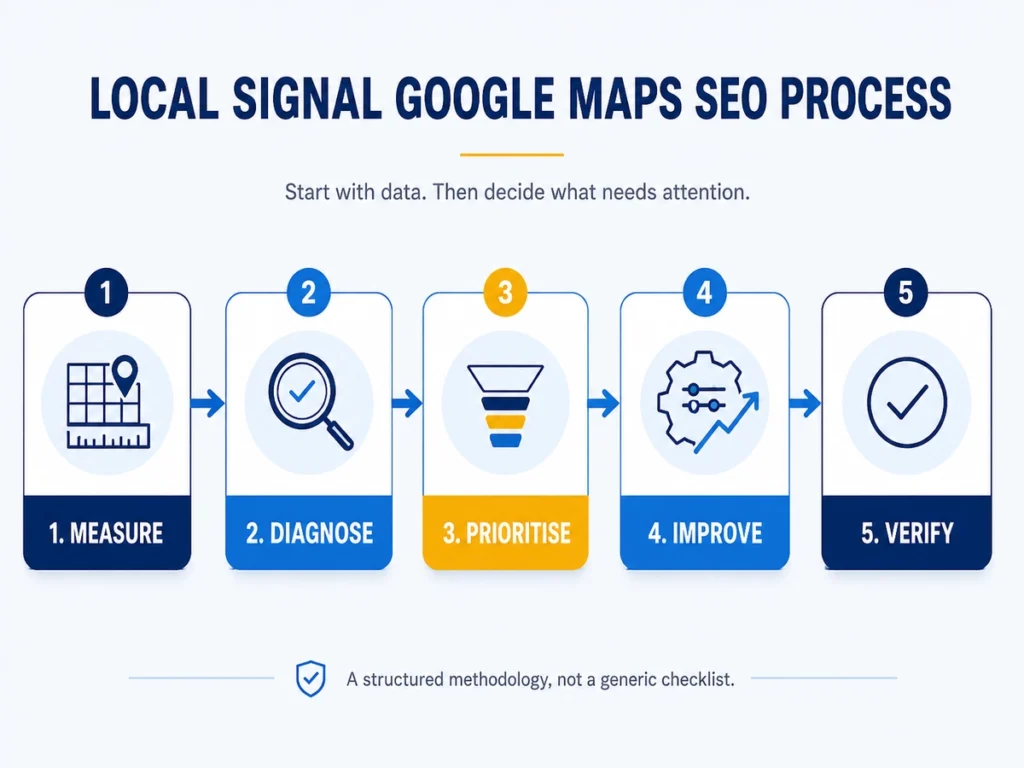
1. Measure the starting point
I begin with the current visibility.
That may include important keywords, geo-grid rankings, Google Business Profile performance, Search Console data and enquiry tracking where available.
The aim is to know what we are starting with.
2. Review the Google Business Profile and website together
I then look at the profile and website as connected parts of the same local presence.
On the profile, I may review areas such as:
- business category
- services
- business information
- service areas
- reviews
- photos
On the website, I look at whether important services, relevant areas and customer proof are properly supported.
3. Find the highest-priority gaps
This is where I avoid doing SEO by checklist.
I ask:
Which problem deserves attention first?
That could be weak service relevance.
It could be poor visibility across an important area.
It could be weak project proof.
It could be outdated business information.
Or the rankings may already be strong while the real problem is that visitors are not turning into enquiries.
The priority depends on what the evidence shows.
4. Improve the areas that need attention
Depending on the business, that may involve:
- improving Google Business Profile information
- strengthening important service pages
- improving useful local pages
- collecting genuine customer reviews
- adding real project proof
- correcting outdated business listings
- improving internal links
- earning relevant local mentions or links
- making quote and contact paths easier to use
I would not do all of these simply because they appear on an SEO checklist.
I would use the ones that make sense for the business.
5. Measure again and verify the change
After the priority work has been completed, I measure again.
Then I compare the result with the original baseline.
Did Maps visibility improve?
Did an important service become stronger?
Did geographic coverage change?
Are more of the right visitors reaching the website?
Are enquiries improving?
Sometimes the result confirms that the priority was correct.
Sometimes it shows that another layer still needs work.
Either way, the next decision comes from evidence rather than guesswork.
That is the process:
Measure → Diagnose → Prioritise → Improve → Verify
If you want to see how I apply this approach over a structured period, see my 8-Week Local SEO Sprint for painters.
Frequently Asked Questions About Google Maps SEO for Painters
Not Sure Why Your Painting Business Is Weak in Google Maps?
If your business is not showing strongly across the areas or painting services that matter, I would start by looking at the current visibility before recommending changes.
Send me your website and Google Business Profile.
I will review the starting point and tell you what I would check first.